🌱 Bird of Paradise (Strelitzia nicolai)
🧾 Quick Facts
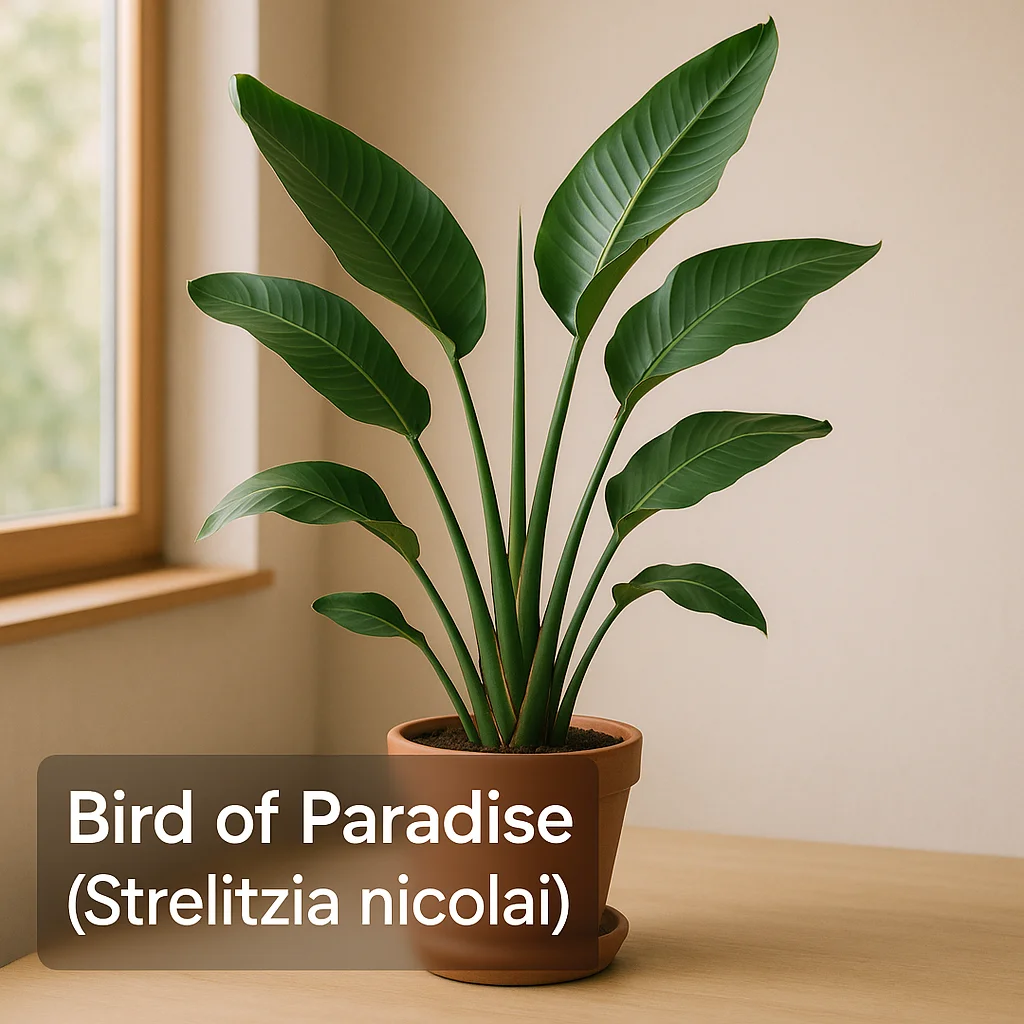
The Bird of Paradise (Strelitzia nicolai) is a striking houseplant known for its lush foliage and potential to produce extraordinary bird-like flowers. While often mistaken for its relative, the Strelitzia reginae, Strelitzia nicolai boasts larger leaves and is primarily grown indoors for its impressive greenery. Here are some quick facts to get acquainted:
- Common names: Bird of Paradise, Giant White Bird of Paradise
- Scientific name: Strelitzia nicolai
- Plant type: Flowering
- Growth habit: Upright
- Typical indoor size range: 4 to 6 feet tall
- Growth speed: Moderate to fast
- Lifespan: Can live many years with care
- Origin: South Africa (subtropical coastal regions)
- Light preference: Bright indirect, tolerates direct sun
- Water needs: Moderate; allow topsoil to dry between waterings
- Temperature & humidity preference: Warm, moderate to high humidity
- Pet safety: May be irritating/toxic to pets
- Difficulty: Medium
🔍 Identification & Look-Alikes
Strelitzia nicolai is recognized by its broad, banana-like leaves that fan out elegantly from a central stem. The leaves are leathery, oblong to lanceolate, and can reach lengths of over 18 inches. Unlike its occasionally flowering relative Strelitzia reginae, Strelitzia nicolai is primarily grown for foliage, with the production of its bird-like flowers being rare indoors.
It's common for the Bird of Paradise to be confused with banana plants (Musa spp.) due to their similar leaf shape.
- Top ID Tips
- Large, banana-like leaves
- Upright growth habit
- Leathery, robust foliage
- Primarily foliage plant indoors
- White bracts and blue petals if flowering
- Central stem with fan-like leaf arrangement
- Similar plants: Banana plant, even Palm species
🌍 Origin & Natural Habitat
The Bird of Paradise hails from the subtropical coastal regions of South Africa, where it flourishes in the wild. It commonly grows along riverbanks and in disturbed forests at low elevations. Its natural habitat is warm and humid, with periods of heavy rainfall followed by dry spells. Understanding its origin helps in replicating similar conditions indoors, ensuring healthy growth.
Knowing the plant's natural love for bright, indirect light and its ability to thrive in humid environments is key to successful indoor cultivation. Ensuring proper air circulation and maintaining moderate humidity indoors can lead to optimal health and potential blooms.
☀️ Light Requirements
The Bird of Paradise thrives in bright indirect light, though it can tolerate some direct sunlight. For best results, place it near an east or south-facing window. While it can manage lower light conditions, this will often result in slower growth and might inhibit its blooming potential.
- Light Checklist
- Prefers bright indirect light
- Can handle some direct sunlight
- Avoid full shade or low light areas
- Watch for leggy growth as a sign of too little light
- Keep slightly away from glass to prevent sun scorch
- Rotate regularly for even growth
- Monitor leaf color to assess light levels
💧 Watering & Humidity
Strelitzia nicolai requires a balance in watering; the soil should be kept slightly moist but not waterlogged. It's best to water thoroughly, allowing excess to drain, then reduce watering frequency as the top few inches of soil dry out. During warmer months, the frequency will increase, while in cooler months, less water will suffice.
Humidity is also essential to mimic the plant's natural environment. Aim for a moderately humid indoor atmosphere. Techniques like using a pebble tray or grouping with other plants can help maintain adequate humidity without needing a humidifier.
- Watering Tips
- Allow top 2 inches of soil to dry between waterings
- Use well-drained pot and saucer
- Increase watering in summer, reduce in winter
- Avoid letting plant sit in waterlogged soil
- Check for leaves drooping as a sign of underwatering
- Use filtered or room-temperature water
- Raise humidity levels if leaf edges brown
🐛 Soil, Pot & Repotting
To accommodate its fast growth, a well-draining and slightly acidic soil mix is ideal for the Bird of Paradise. A mixture of potting soil, sand, and perlite or orchid bark will ensure proper drainage. When selecting a pot, opt for one with drainage holes, and consider terracotta to aid in moisture regulation.
Young plants may need annual repotting due to rapid growth, while mature plants can be repotted every 2 to 3 years. When roots emerge from the pot, or growth slows significantly, it's time to upgrade to a slightly larger pot, ensuring minimal root disturbance.
- Repotting Checklist
- Use well-draining soil mix
- Choose pots with drainage holes
- Repot annually for young plants
- Accommodate mature plants every 2–3 years
- Scout for roots emerging from pot holes
- Retain some soil from the old pot to blend in the new
- Minimize root disturbance during repotting
🌡️ Temperature, Airflow & Seasonal Care
The Bird of Paradise prefers temperatures between 65°F to 75°F. It is generally forgiving of normal household temperature swings but does not tolerate cold drafts. Keep it away from vents or doors to avoid sudden temperature changes.
During winter, the plant’s growth slows, reducing both watering and feeding to adjust to its temporary dormancy period. Helping the plant acclimate to indoor environmental shifts with proper airflow can prevent common indoor plant issues.
- Seasonal Notes
- Optimal temperature is 65°F–75°F
- Avoid cold drafts and sudden temperature drops
- Reduce watering in winter
- Ensure ample airflow to fight fungal problems
- Place away from heat sources like radiators
- Pause fertilization during dormancy
- Replicate spring-like conditions to stimulate growth
🌸 Flowers, Fruit & Growth Cycle
Strelitzia nicolai may flower indoors, although blooms are less common than they are in outdoor settings. When they do, expect striking white and blue flowers that resemble a bird in flight, mainly appearing in optimal light and environmental conditions.
Throughout its growth cycle, new leaves unfurl from the plant's central stem. Pruning is mainly for aesthetic purposes or to remove any damaged leaves, always ensuring clean, sterilized tools to prevent infections.
🧬 Propagation & Reproduction
Propagation of the Bird of Paradise is best achieved through division, especially for mature plants. Division should be performed during repotting sessions by carefully separating root clumps and replanting them individually. Seed propagation is possible but requires more expertise and patience.
For those less experienced in propagation, it is generally advised to purchase new plants rather than attempting seed propagation.
- Propagation Tips
- Propagate by division during repotting
- Ensure each division has a healthy root system and leaves
- Plant divisions in well-draining soil
- Water new plants gently after propagation
- Avoid seed propagation unless experienced
🌿 Common Problems, Pests & Prevention
Common problems for Strelitzia nicolai include yellowing leaves, brown leaf edges, and drooping due to inappropriate watering. Poor light conditions can lead to leggy growth. Adapt your care routine to fit seasonal and environmental changes to maintain plant health.
Pests like spider mites, mealybugs, and scale are occasionally a concern. Regularly cleaning leaves and ensuring proper plant hygiene alongside proper humidity can assist in pest prevention.
- Prevention Basics
- Maintain consistent watering schedule
- Ensure bright, indirect light
- Clean leaves regularly with a damp cloth
- Isolate new plants to prevent pest spread
- Monitor for pests and treat promptly
- Sure up airflow to prevent mold and fungus
- Prune away damaged or diseased leaves
🐾 Pet & Home Safety Notes
Bird of Paradise plants are noted for being potentially irritating or toxic if ingested by pets, particularly cats and dogs. Some reports suggest that ingestion can cause discomfort or sickness. To mitigate risks, place the plant out of reach of curious pets. In case of ingestion, contact a professional or local poison control resources for advice.
🏡 Styling Ideas & Best Room Placement
The Bird of Paradise makes a statement in any room with its majestic leaves, whether styled in bright living rooms or as a centerpiece in luxuriant bathrooms. It's ideal for rooms with high ceilings due to its height potential. Consider pairing it with floor pots or utilizing it in open-plan spaces near windows where light is abundant.
For decorative synergy, opulent tropical plants such as Monstera or Philodendrons complement its commanding presence.
📌 Summary
- Recognizable by its large, banana-like leaves
- Native to South Africa's subtropical coasts
- Requires bright, indirect light; tolerates some direct sun
- Moderate watering, allowing soil to partially dry
- Well-draining soil and semi-annual repotting ideal
- Preferable temperatures between 65°F and 75°F
- Propagation via division, challenging with seeds
- Watch for pests like spider mites and scale
- May be toxic to pets; keep out of reach
- Medium difficulty with care needs suited for attentive plant enthusiasts