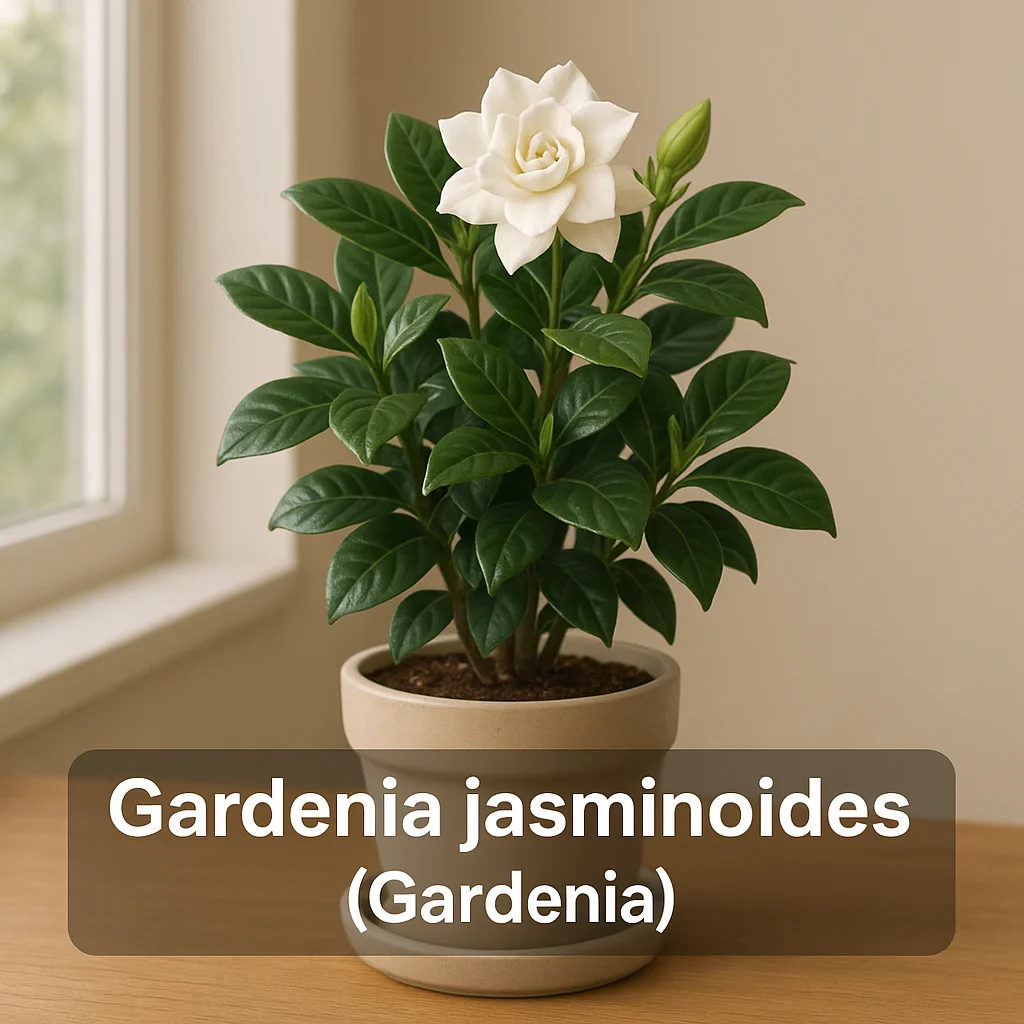
🌱 Gardenia jasminoides (Gardenia)
🧾 Quick Facts
Gardenia jasminoides, commonly referred to as gardenia, is celebrated for its exquisite fragrance and glossy foliage. This flowering houseplant can be a bit challenging to care for but is deeply rewarding with the right conditions. Here are some key facts about gardenia:
- Common names: Gardenia, Cape Jasmine
- Scientific name: Gardenia jasminoides
- Plant type: Flowering shrub
- Growth habit: Shrub-like, compact
- Typical indoor size range: 1 to 3 feet tall, 1 to 2 feet wide
- Growth speed: Moderate
- Lifespan: Can live many years with proper care
- Origin: Asia, specifically China and Japan
- Light preference: Bright indirect light
- Water needs: High; soil should remain consistently moist but not soggy
- Temperature & humidity preference: Warm temperatures and high humidity
- Pet safety: Some sources list as irritating/toxic to pets
- Difficulty: Advanced
🔍 Identification & Look-Alikes
Gardenia is recognized for its dark green, glossy leaves and intoxicatingly fragrant white to cream flowers. The leaves are typically oval-shaped, arranged oppositely or in whorls. Stems are woody, denoting its shrub-like growth. Variegation in leaves is uncommon but can occur in some cultivars under specific light conditions. Indoors, gardenias are grown mainly for their aromatic flowers, which are a hallmark trait.
Common look-alikes include Cape Jasmine and some Camellia species. Distinguishing gardenias typically involves examining the flower shape and fragrance.
- Leaves are dark green and glossy, oval-shaped
- Flowers are white or cream, highly fragrant
- Woody stems and compact, rounded form
- Grown mainly for its flowers, not foliage
- Variegated leaves are rare
- Camellia look-alike: differentiate by fragrance
- Opposite leaf arrangement
- Compact shrub-like form indoors
- Leaves remain evergreen year-round
🌍 Origin & Natural Habitat
Gardenia jasminoides is native to the tropical and subtropical regions of Asia, specifically China and Japan. In its natural habitat, it thrives in forested areas, often found in the understory where it receives filtered sunlight through the canopy. Gardenia prefers warm, humid conditions, mirroring a tropical climate. Knowledge of its origin helps understand the need for high humidity and filtered light, crucial for indoor care.
☀️ Light Requirements
Gardenias thrive best in bright, indirect light. Aim to place your gardenia near a south or west-facing window, ensuring it receives plenty of light while avoiding harsh, direct sunlight which can scorch its leaves. Bright but gentle morning light is ideal. Light influences both bloom production and leaf health; too little light results in fewer blooms, while excessive direct sunlight might damage foliage.
- Best placement: Near a south or west-facing window
- Bright indirect light recommended for best blooms
- Morning sun is safer than afternoon sun
- Avoid direct sunlight to prevent leaf scorch
- Insufficient light leads to reduced flowering
- Filtered light mimics natural habitat conditions
- Adjust positioning if leaf yellowing occurs
- Rotate plant occasionally for even growth
- Supplement with grow lights if needed
💧 Watering & Humidity
Water gardenias consistently using a soak-and-drain approach, allowing the top inch of soil to dry slightly between waterings. Over or underwatering can cause issues like leaf drop or yellowing. Pot size and light exposure can affect watering frequency; smaller pots or brighter light often require more frequent watering.
Gardenias need high humidity. Use a humidifier or a tray with water and pebbles to increase humidity safely. By misting, be cautious to avoid promoting fungal issues. Always water with lukewarm water to prevent shocking the roots.
- Maintain consistent moisture level, avoid soggy soil
- Let the top inch of soil dry slightly
- Use lukewarm water for watering
- Humidity enhancements: tray with water, humidifier
- Leaf yellowing may indicate poor watering practice
- Mist carefully to avoid fungal problems
- Water more frequently in smaller pots
- Seasonal adjustments: less in winter, more in summer
- Observe plant signs and adjust care accordingly
🐛 Soil, Pot & Repotting
Use an acidic, well-draining soil mix for gardenias, ideally formulated for acid-loving plants. Gardenias prefer a robust drainage system; pots with drainage holes are essential. Consider clay or terracotta pots that allow for better aeration.
Repotting should be done when gardenias become root-bound or show stunted growth. Spring is ideal for repotting, choosing a pot only slightly larger than the current one to avoid overpotting. During repotting, gently untangle roots and refresh the soil.
- Acidic, well-draining soil mix preferred
- Pots must have drainage holes
- Terracotta pots recommended for better aeration
- Repot during spring when root-bound
- Choose a pot that is one size larger
- Observe roots for signs of binding
- Fresh soil boosts plant health after repotting
- Water thoroughly after repotting
- Repotting encourages new growth
🌡️ Temperature, Airflow & Seasonal Care
Gardenias favor warm temperatures ranging from 65°F to 75°F. Provide stable temperatures without sudden fluctuations, avoiding exposure near cold drafts or hot air vents. Ensure good airflow to minimize fungal issues, especially in high humidity settings.
Adjust watering during the winter months to reflect slower growth and allow the plant to rest. Note that gardenias may enter a dormancy period with lower light and cooler temperatures.
- Optimal temperature: 65°F to 75°F
- Avoid temperature extremes and drafts
- Ensure minimal airflow to prevent fungal issues
- Adjust watering based on seasonal growth changes
- Recognize slower growth in winter
- Consider moving away from air vents in winter
- Gardenia may enter dormancy in cooler months
- Warm and stable environment preferred
🌸 Flowers, Fruit & Growth Cycle
Gardenias bloom indoors, typically in late spring or early summer, provided they are cared for properly. The flowers are strikingly white and highly aromatic. Indoor gardenias rarely produce fruit. Growth occurs as new leaves and stems develop, ideally with dense foliage.
Prune lightly after blooming to retain shape and encourage further growth. Ensure tools are sanitized to prevent disease transfer.
🧬 Propagation & Reproduction
Gardenias can be propagated through stem cuttings. Take a stem cutting in late spring or early summer when the plant is actively growing. Ensure the cutting includes a few leaves and at least one node. Dip in rooting hormone and plant in a well-draining, slightly acidic mix. Cover with a plastic bag to maintain humidity, ensuring it doesn't touch the cutting.
Propagation from seeds is possible but less common due to the challenging germination conditions which may not be worthwhile for most indoor growers.
- Use stem cuttings for propagation
- Take cuttings in late spring or early summer
- Cutting should have at least one node
- Apply rooting hormone before planting
- Provide high humidity to encourage rooting
- Rooting can take several weeks
- Propagation from seeds is challenging
🌿 Common Problems, Pests & Prevention
Common issues with gardenias include yellow leaves, brown tips, and flower bud drop, often stemming from improper watering, humidity, or light. Ensure stable, correct care to prevent these problems.
Pests such as spider mites, mealybugs, and scale can infest gardenias. Quarantine new plants, maintain leaf cleanliness, and ensure proper airflow to minimize the risk. Avoid overwatering to prevent fungus gnats.
- Keep leaves clean to prevent pests
- Monitor soil moisture to avoid fungal gnats
- Regularly check for signs of pests
- Quarantine new plants to avoid pest spread
- Stable care helps prevent common issues
- Remove pests manually if found
- Ensure proper airflow around the plant
- Avoid sudden changes in care routine
- Inspect frequently for early problem detection
🐾 Pet & Home Safety Notes
Gardenias may be irritating if ingested by pets or children. Generally, it's advised to place them out of reach or use barriers to prevent access. If ingestion is suspected, contact a professional or local poison control resource for guidance.
🏡 Styling Ideas & Best Room Placement
Gardenias are elegant additions to any room but do well in places with high humidity such as bathrooms or kitchens, given that light and airflow conditions are suitable. They make a stylish impact on coffee tables, near bright windows, or as the focal point of a bright room. Pair gardenias with ferns or peace lilies for a lush, tropical vibe.
- Bathrooms or kitchens for higher humidity
- Place near bright windows as a focal point
- Pair with ferns and peace lilies
- Use in decorative pots to enhance aesthetics
- Avoid drafty or hot air exposure
📌 Summary
- Recognizable by fragrant white flowers and glossy leaves
- Native to Asia, thrives in warm, humid conditions
- Requires bright indirect light for best bloom production
- Consistent watering, with slightly dry surface before rewatering
- Acid-loving plant: choose well-draining, acidic soil
- Prefers stable, warm temperatures; sensitive to drafts
- Advanced care level: propagate via stem cuttings
- Common pests include spider mites and scale, mainly from improper care
- Placement: high-humidity rooms with warm light
- May irritate pets if ingested; place strategically out of reach