🌱 Guzmania (Bromeliad)
🧾 Quick Facts
Guzmania, a member of the Bromeliad family, is a popular choice for indoor plant enthusiasts due to its striking appearance and relatively easy care. These plants are native to the tropical regions of Central and South America. Guzmanias are known for their vibrant, colorful bracts and rosette-forming foliage. While care requirements are generally consistent, slight variations exist between different species and hybrids commonly sold under this name.
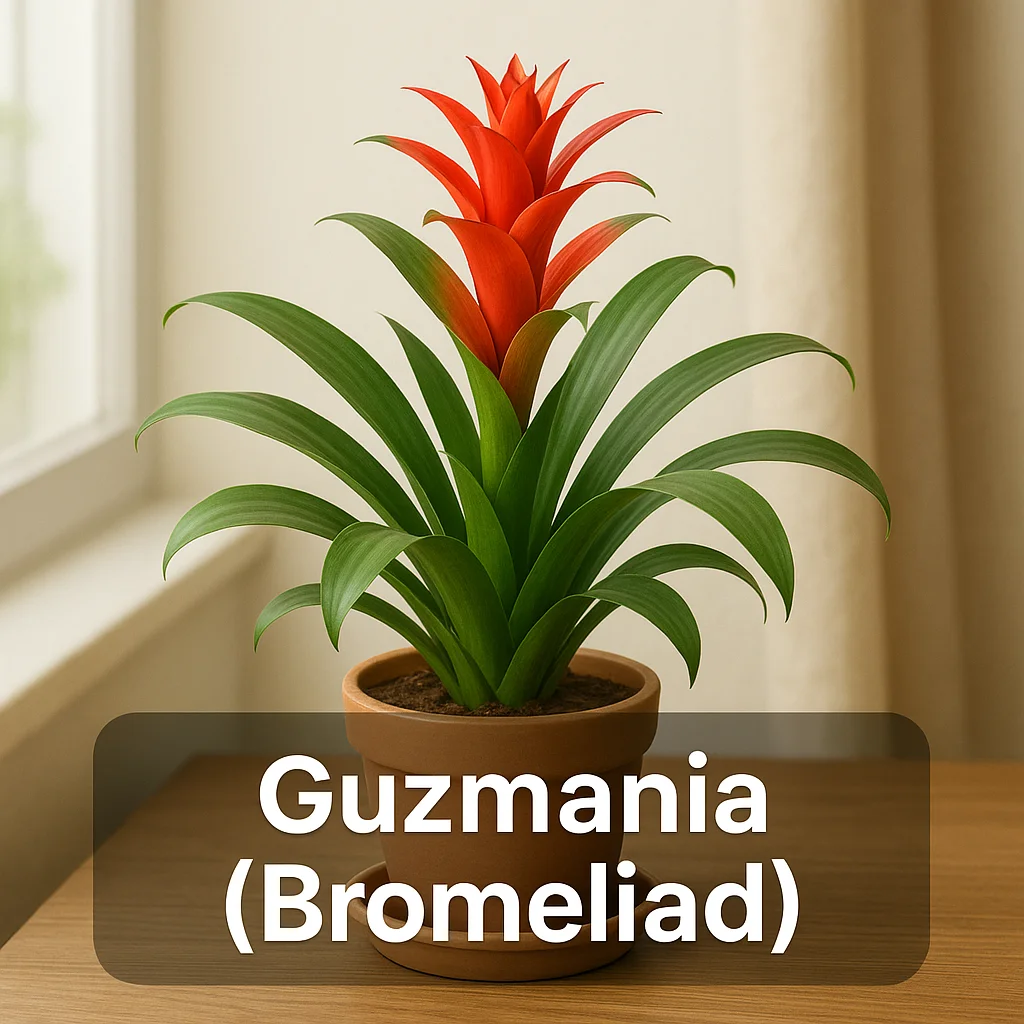
- Common names: Guzmania, Bromeliad
- Scientific name: Guzmania spp.
- Plant type: Flowering
- Growth habit: Rosette
- Typical indoor size range: 1 to 2 feet in height and spread
- Growth speed: Slow to moderate
- Lifespan: Can live many years with proper care
- Origin: Central and South America
- Light preference: Bright indirect
- Water needs: Moderate, prefers not to dry out completely
- Temperature & humidity preference: Warm temperatures; high humidity
- Pet safety: May be irritating/toxic to pets
- Difficulty: Medium
🔍 Identification & Look-Alikes
Guzmanias are characterized by their rosette formation, with long, narrow leaves that can range from bright green to dark green. The leaves are smooth and sturdy, often with a slightly leathery texture. Their most distinctive feature is the colorful bracts that rise from the center of the rosette, varying in shades of red, orange, yellow, or pink. These bracts are often mistaken for flowers, but the true flowers are small and usually emerge from the bract zone. Guzmania can be confused with other bromeliads like Tillandsia or Aechmea. However, Guzmania's bracts are typically more vibrant, and the plant is distinctive for its smooth, spineless leaves.
- Long, narrow, smooth leaves arranged in a rosette
- Often bright, colorful central bracts
- Small true flowers emerge from bracts
- Look for spineless leaf edges
- Variegation is uncommon, usually solid green leaves
- Bracts may change colors under different light
- Often mistaken for other bromeliads for similar features
🌍 Origin & Natural Habitat
The Guzmania is native to the tropical rainforests of Central and South America. They are typically found as epiphytes, meaning they grow on other plants and trees, utilizing them as structural support while deriving moisture and nutrients from the air and rain. These areas exhibit warm climates with high humidity, offering filtered light from the forest canopy. Understanding their natural habitat helps in replicating similar conditions indoors. This involves maintaining high humidity and warm temperatures while providing filtered light to prevent scorched leaves.
☀️ Light Requirements
Guzmanias prefer bright indirect light to thrive, mimicking the dappled sunlight of a rainforest canopy. A north or east-facing window is ideal, where the light is gentle and not direct. Avoid direct sunlight as it can cause the leaves to scorch or the bracts to lose their vibrant color. Insufficient light may lead to leggy growth or dull bracts.
- Place near east or north-facing windows
- Bright indirect light enhances bract color
- Avoid direct sunlight to prevent scorch
- Watch for pale leaves as a sign of too much sun
- Dull bracts might indicate low light
- Variegation not common, so light mainly affects bract vibrancy
💧 Watering & Humidity
Guzmanias require consistent moisture, but their roots should not sit in water. Water directly into the center rosette, known as the "cup." Empty this "cup" periodically to prevent stagnation. Allow the topsoil to dry slightly between waterings. They thrive in high humidity environments. Consider using a pebble tray or a humidifier, especially in dry climates. Avoid misting directly onto the bracts to prevent rot. Overwatering symptoms include root rot while underwatering may cause browning leaf tips.
- Water into the center "cup," not the soil base
- Keep soil lightly moist but not soggy
- Regularly drain and refresh center "cup"
- High humidity benefits overall health
- Use pebble tray or humidifier for added humidity
- Avoid leaf rot by not misting bracts directly
🐛 Soil, Pot & Repotting
Use a well-draining orchid or bromeliad mix, which allows air to easily reach the roots. A pot with drainage holes is crucial, and a shallow pot can suffice due to the plant's root structure. Repot every two to three years or when the plant outgrows its container. Carefully remove the plant, shake off the old soil, and place it in fresh mix. Opt for a pot that’s only slightly larger than the current one. Ensure not to disrupt the root system excessively.
- Preferred soil: orchid or bromeliad mix
- Ensure pot has adequate drainage
- Repot every 2–3 years
- Gently handle the root system
- Use a pot just slightly larger than the previous
- Repot if growth appears stalled or water drains too quickly
🌡️ Temperature, Airflow & Seasonal Care
Guzmanias prefer temperatures between 60°-80°F (15°-27°C). They dislike cold drafts and sudden temperature changes, which can impede growth. Ensure good airflow around the plant, but keep away from direct air from heaters or air conditioners. In winter, growth may slow, necessitating a reduced watering schedule. Keep the plant warm, away from chilly windows and drafty spots, and maintain humidity levels.
- Ideal temperature: 60°-80°F (15°-27°C)
- Avoid cold drafts and sudden temperature changes
- Place away from direct AC or heater vents
- Switch to a reduced watering schedule in winter
- Maintain high humidity even in cooler months
🌸 Flowers, Fruit & Growth Cycle
While Guzmanias are cherished for their vibrant bracts, not the actual flowers, they rarely produce berries indoors. The eye-catching bracts can last several months. After flowering, the plant will eventually die back, but not before producing offsets or "pups" that carry on the lifecycle. Trim away spent bracts to encourage good air circulation, and maintain the plant's aesthetic. Dead foliage can also be pruned to keep the plant fresh.
🧬 Propagation & Reproduction
Propagation of Guzmania is commonly done through the division of offsets or "pups," which emerge at the base of the plant. Wait until the pups are about a third the size of the parent plant before carefully separating them to pot individually. It’s rare and challenging to grow Guzmanias from seed indoors because the process is complex and requires specific conditions.
- Wait for pups to reach a third of the parent size
- Carefully remove pups for separate potting
- Use similar soil mix for offsets
- Ensure pups are healthy with visible roots before removal
- Propagation by seed is uncommon for home growers
🌿 Common Problems, Pests & Prevention
Common problems with Guzmanias include yellow leaves and brown tips, often due to incorrect watering or humidity levels. Mealybugs and spider mites may occasionally be a problem. Inspect and clean leaves regularly to keep pests at bay. Proper airflow and stable environmental conditions reduce stress and pest susceptibility.
- Watch for yellowing leaves as a sign of stress
- Maintain correct water and humidity balance
- Regularly clean leaves to remove dust and pests
- Remove dead plant materials promptly
- Isolate new plants to prevent pest spread
- Stable care prevents stress-induced issues
🐾 Pet & Home Safety Notes
While some sources list Guzmania as irritating, its overall toxicity is generally low. As a precaution, keep out of reach of pets and children. If plant parts are ingested, contacting a professional or local poison control resources is advisable. Placement strategies such as high shelves or hanging baskets can help prevent accidental ingestion.
🏡 Styling Ideas & Best Room Placement
Guzmania's striking appearance makes it an excellent choice for bright indoor spaces like living rooms, where indirect light can highlight its vibrant bracts. High humidity environments such as bathrooms and kitchens are also ideal. They can be displayed beautifully in hanging baskets, adding a tropical feel to shelves or mantles. Pair Guzmania with other bromeliads or ferns for a lush, tropical collection.
📌 Summary
- Distinctive colorful bracts and rosette-forming foliage
- Native to Central and South American tropical regions
- Bright indirect light optimizes growth and bract color
- Water to keep center "cup" moist; drain often
- Use well-draining orchid or bromeliad mix for potting
- Adapt care to seasonal changes; slow growth in winter
- Propagate from pups for new plants
- Watch for common pests like mealybugs
- Medium difficulty; may irritate pets if ingested
- Ideal for adding color to bright and humid rooms