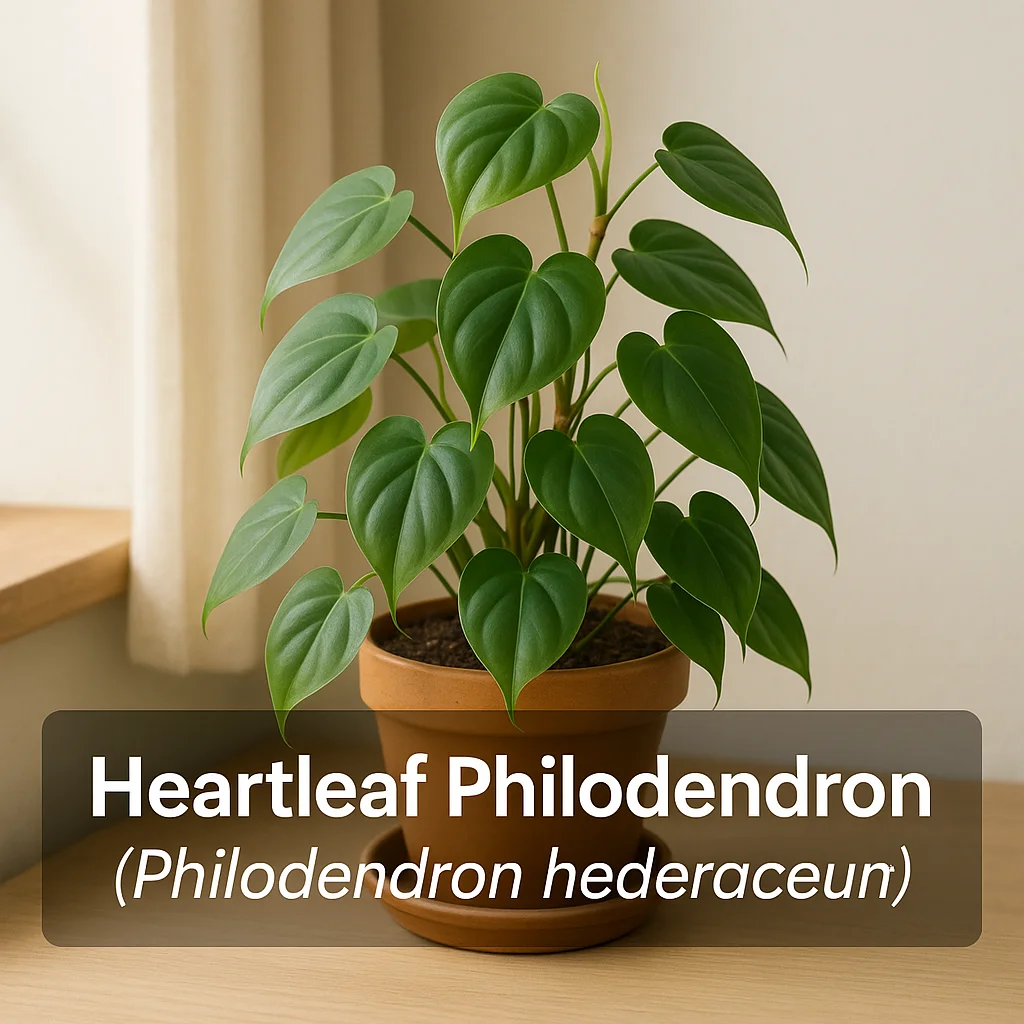
🌱 Heartleaf Philodendron (Philodendron hederaceum)
🧾 Quick Facts
The Heartleaf Philodendron, known scientifically as Philodendron hederaceum, is a beloved houseplant for its easy care and attractive foliage. It's often found in homes and offices, thriving in various indoor conditions.
- Common names: Heartleaf Philodendron, Sweetheart Plant
- Scientific name: Philodendron hederaceum
- Plant type: Vine
- Growth habit: Trailing or climbing
- Typical indoor size: 2-4 feet in length
- Growth speed: Moderate to fast
- Lifespan: Can live many years with proper care
- Origin: Central and South America
- Light preference: Medium to bright indirect light; tolerates low light
- Water needs: Moderate; prefers drying out slightly between waterings
- Temperature & humidity preference: Warm temperatures; moderate to high humidity
- Pet safety: May be irritating or toxic if ingested
- Difficulty: Easy
🔍 Identification & Look-Alikes
The Heartleaf Philodendron is recognized by its glossy, heart-shaped leaves, which are typically deep green, though some varieties may feature variegation. The leaves are smooth to the touch and emerge from slender stems, which can grow extensively as the plant matures. Typically, this plant is grown for its foliage, as it rarely flowers indoors.
In terms of look-alikes, the Heartleaf Philodendron is often confused with pothos. While pothos has thicker, waxier leaves with a slight texture, the Philodendron's leaves are typically smoother and thinner. Another distinguishing feature is the presence of small aerial roots along the stems of the Philodendron, which is less pronounced in pothos.
- Top ID Tips:
- Heart-shaped leaves with glossy surface
- Thin, long stems with potential for long trailing growth
- Smooth leaves, not as thick as pothos
- Rarely flowers indoors, primarily grown for leaves
- Uniform green or slight variegation depending on light
- Presence of small aerial roots along stems
- Distinguished from pothos by leaf texture and root presence
🌍 Origin & Natural Habitat
Native to the tropical regions of Central and South America, the Heartleaf Philodendron typically grows as an understory plant in rainforests. It often climbs or trails along the forest floor, benefiting from the filtered light found in its natural habitat. These plants are accustomed to warm temperatures and high humidity levels.
Understanding its natural habitat helps indoor growers replicate similar conditions. The plant thrives in consistent humidity and prefers environments with moderated sunlight, similar to the dappled light of forest canopies.
☀️ Light Requirements
The Heartleaf Philodendron flourishes in medium to bright indirect light. It can tolerate low light conditions, though its growth rate may slow, and variegated varieties may lose their pattern in low light. Direct sunlight should be avoided as it can scorch the leaves.
Examples of bright indirect light include positions near east or north-facing windows, or near south-facing windows with some sheer curtain filtering the sun.
- Light Checklist:
- Avoid direct sunlight to prevent leaf scorching
- Place near east or north-facing windows
- Use sheer curtains for south or west-facing windows
- Watch for fading variegation as a sign of too little light
- Yellowing leaves may indicate too much light
- Use grow lights if natural light is insufficient
💧 Watering & Humidity
The Heartleaf Philodendron prefers a soak-and-dry watering approach. Allow the top inch of soil to dry out between waterings, and ensure good drainage to prevent waterlogging. During colder months, the frequency may decrease as the plant's growth slows.
Humidity levels should be moderate to high. Consider techniques like grouping plants, using humidifiers, or setting the plant on a pebble tray to increase the ambiance humidity naturally.
- Watering Tips:
- Water when top inch of soil is dry
- Ensure pot has drainage holes
- Reduce watering in colder months
- Yellow leaves may indicate overwatering
- Brown tips could signal underwatering
- Increase humidity with pebble trays or room humidifiers
🐛 Soil, Pot & Repotting
Heartleaf Philodendrons require a well-draining potting mix, ideally one that allows for some moisture retention without becoming compacted. A general mix of peat, perlite, and potting soil works well. When selecting pots, choose ones with enough drainage holes to prevent water buildup.
Repotting is typically necessary every couple of years or when the roots begin to circle the pot or protrude from drainage holes. It's best to move up just one pot size at a time to avoid overwhelming the plant with too much space.
- Repotting Checklist:
- Use a well-draining potting mix with peat and perlite
- Ensure pot has sufficient drainage holes
- Repot when roots are congested or visible
- Increase pot size gradually
- Check root health during repotting
- Do not start with a pot too large for the plant
🌡️ Temperature, Airflow & Seasonal Care
The Heartleaf Philodendron thrives in temperatures between 65°F to 75°F (18°C to 24°C). Avoid sudden cold drafts and fluctuate as this can shock the plant. Ensure sufficient airflow to prevent mold and pests, but avoid placing it directly in line of fans or vents.
During winter, as growth slows, adjustments to watering schedule should be made accordingly. The plant generally doesn't enter a full dormancy but may show reduced vigor.
- Seasonal Notes:
- Avoid temperature below 60°F (15°C)
- Pay attention to lighting changes in winter
- Reduce watering in cooler months
- Avoid placement near heaters and AC vents
- Monitor for reduced growth in winter as normal
🌸 Flowers, Fruit & Growth Cycle
While Heartleaf Philodendrons rarely flower indoors, if at all, their foliage remains their main attraction with new leaves emerging from the terminal ends of vines. The growth is typically consistent and can be managed with regular pruning to encourage bushier development and control size.
Regular grooming will help maintain the plant's appearance, and it's advised to clean foliage of dust to enhance transpiration and prevent pest issues.
🧬 Propagation & Reproduction
Propagation of Heartleaf Philodendrons is straightforward and often done via stem cuttings. Cuttings should be taken just below a node with a healthy leaf or two attached. These can be rooted in water or directly in soil.
For division, ensure that each section has roots and a couple of leaves to sustain growth.
- Propagation Tips:
- Use sharp, clean scissors for cuttings
- Choose a node area for cutting, remove any flowers or buds
- Root cuttings in water for visibility or soil for direct planting
- Division should include viable roots
- Place propagated sections in medium light
🌿 Common Problems, Pests & Prevention
Potential issues in the Heartleaf Philodendron include yellow leaves due to overwatering, brown tips from underwatering, or leggy growth from insufficient light. Common pests include spider mites, mealybugs, and scale.
Regular monitoring and cleaning of leaves are crucial for prevention. Providing stable care and avoiding overwatering can further deter common issues.
- Prevention Basics:
- Inspect new plants before introducing them
- Regularly clean leaves to keep dust and pests at bay
- Mist leaves lightly to maintain humidity
- Check soil moisture before watering
- Provide even lighting and rotate plant for uniform growth
- Isolate infested plants to avoid spread
🐾 Pet & Home Safety Notes
Heartleaf Philodendrons contain insoluble calcium oxalates that can cause mild irritation if ingested by pets and humans. It's advisable to place the plant out of reach of small children and pets. If ingestion is suspected, contact a professional or local poison control resources.
For safer placement, consider hanging baskets or elevated shelves, ensuring they are secure from falling.
🏡 Styling Ideas & Best Room Placement
Due to their trailing nature, Heartleaf Philodendrons are perfect for hanging baskets, draping over shelves, or climbing up moss poles. They thrive in various rooms, from bathrooms with higher humidity to living rooms with ample indirect light.
Consider pairing them with other humidity-loving plants like ferns and snake plants for a lush, tropical aesthetic.
📌 Summary
- Characteristic heart-shaped, glossy leaves
- Native to Central and South America rainforests
- Thrives in medium to bright indirect light
- Water moderately, allowing drying between sessions
- Prefers peat-based, well-draining soil
- Comfortable in 65°F to 75°F, avoiding cold drafts
- Easy propagation via stem cuttings
- Common issues: yellow leaves, brown tips, spider mites
- Generally easy care makes it suitable for beginners
- Potentially irritating if ingested, handle with care