🌱 Sedum morganianum (Burro’s Tail)
🧾 Quick Facts
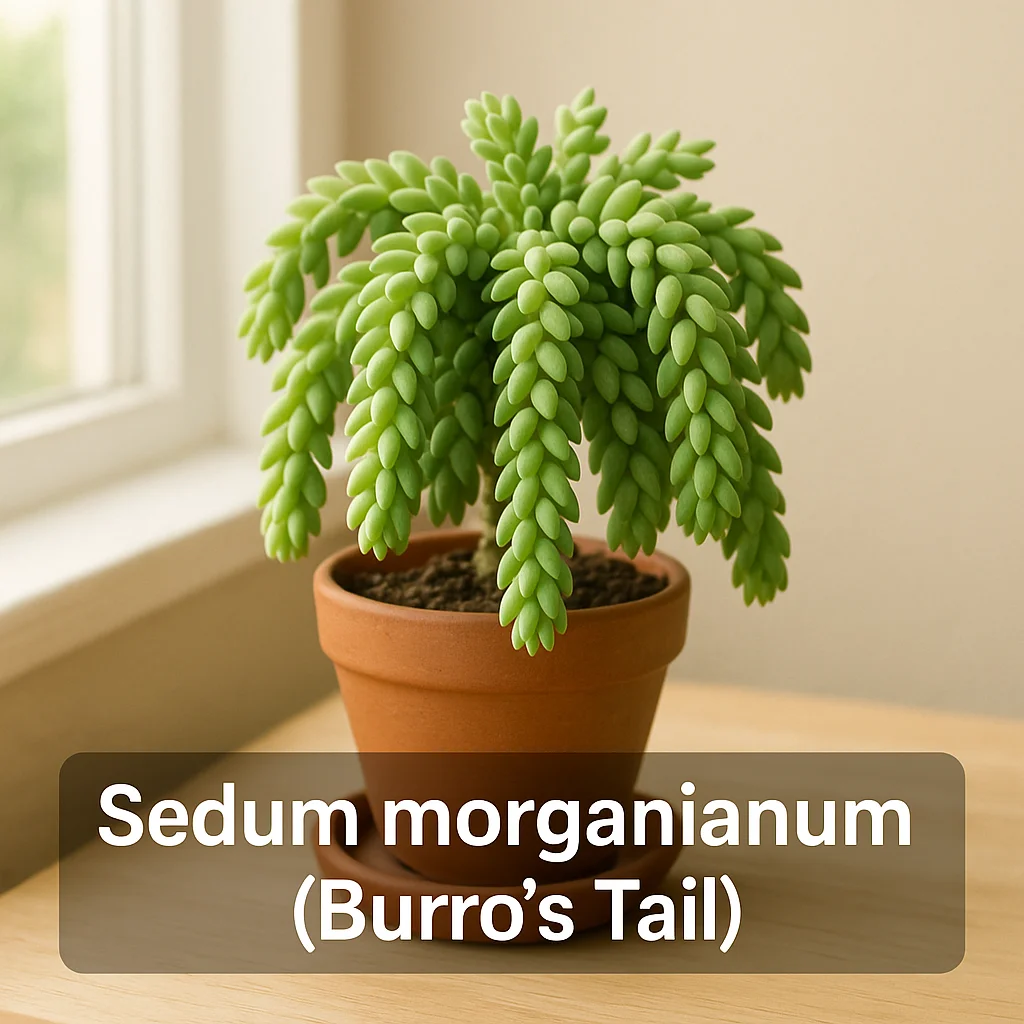
Sedum morganianum, commonly known as Burro’s Tail, is a captivating succulent renowned for its distinctive trailing form. Ideal for indoor growth, this plant thrives with minimal fuss and is celebrated for its ornamental appeal.
- Common names: Burro’s Tail, Donkey’s Tail
- Scientific name: Sedum morganianum
- Plant type: Succulent
- Growth habit: Trailing
- Typical indoor size: Trails 2 to 3 feet
- Growth speed: Moderate
- Lifespan: Can live many years with care
- Origin: Mexico and Honduras
- Light preference: Bright indirect light
- Water needs: Low, prefers to dry out between waterings
- Temperature & humidity preference: Enjoys warmth and moderate to low humidity
- Pet safety: May be irritating to pets
- Difficulty: Easy
🔍 Identification & Look-Alikes
Sedum morganianum is distinguished by its fleshy, bluish-green leaves that are densely packed along gently trailing stems. Each leaf is teardrop-shaped, smooth to the touch, and often gives a slight powdery appearance due to its natural coating. Typically, the stems can trail up to 2-3 feet, creating a cascading effect that is striking when viewed from above.
Though it occasionally flowers, Sedum morganianum is primarily cultivated for its foliage. Flowers comprise small, pink buds that bloom at the stems' tips under optimal conditions. While somewhat rare indoors, the noteworthy aspect of this plant remains its pendant-like, leaf-overlaid stems.
This plant may be confused with other trailing succulents, such as the String of Pearls (Senecio rowleyanus), which can be differentiated by its bead-like leaves.
- Top ID Tips
- Look for dense, overlapping teardrop-shaped leaves
- Blue-green color with a light powdery coating
- Long trailing stems up to 3 feet
- Small, pink flower clusters when blooming
- Stems can be fragile, handle with care
- Feels slightly waxy due to natural leaf coatings
🌍 Origin & Natural Habitat
Native to the mountainous regions of Mexico and Honduras, Sedum morganianum naturally thrives in environments that emulate semi-arid conditions. Typically found in rocky outcrops and sometimes in deciduous forests, the plant adapts to well-draining substrates and enjoys bright conditions. Understanding this natural habitat guides indoor care; maintaining well-drained soil and bright, indirect lighting reflects its native conditions.
☀️ Light Requirements
For optimal growth, place Sedum morganianum in a bright, indirect light environment. An east or west-facing window often provides the right balance of morning or late afternoon light without the scorching midday sun. While the plant tolerates some direct sun, too much can lead to leaf scorch.
Indirect light can be understood as areas illuminated brightly but not exposed to direct sunbeams; this helps maintain its lush color and minimizes leaf burn. If placed in inadequate lighting, the plant may become leggy and lose its compact form.
- Light Checklist
- Place near east or west-facing window
- Avoid prolonged exposure to midday sun
- Observe leaf color and growth habits for lighting adjustments
- Rotate plant periodically for even growth
- Consider supplementing with grow lights in less sunny climates
💧 Watering & Humidity
Sedum morganianum prefers a soak-and-dry watering method. Allow the soil to dry out completely between waterings; overwatering can easily lead to root rot. Adjust watering frequency with seasonal changes—in summer, water every couple of weeks, while winter demands less frequent watering.
Despite its origin from moderate climates, Burro’s Tail is not fussy about humidity levels. Most typical indoor humidity levels suit it, though keeping it in locations free from excessively damp air is beneficial.
- Watering Tips
- Use a well-draining soil mix to prevent water retention
- Check for dry soil before watering again
- Pot size influences drying rate; smaller pots dry faster
- Reduce watering in cooler months
- Signs of too much water: mushy leaves, root rot
- Too little water: shriveling leaves, stunted growth
🐛 Soil, Pot & Repotting
The ideal soil mix for Sedum morganianum is one that mimics its natural rocky substrates, meaning well-draining and gritty. Use cactus or succulent soil mix, enhancing it with perlite or coarse sand if needed. When selecting a pot, ensure it has drainage holes to prevent water from pooling at the roots. Terracotta pots are preferable as they allow evaporation through the walls, drying the soil more evenly.
Repotting is rarely needed more than once every couple of years, ideally during spring when the plant might outgrow its pot. Signs that indicate repotting includes water quickly draining through, roots appearing in drainage holes, or visibly slowed growth.
- Repotting Checklist
- Use cactus/succulent soil mix
- Add perlite for additional drainage
- Repot every 2-3 years or as needed
- Transfer to next pot size that’s slightly larger
- Handle stems carefully to avoid breakage
🌡️ Temperature, Airflow & Seasonal Care
Sedum morganianum enjoys warm indoor temperatures, ideally between 65°F and 80°F (18°C-27°C). While adaptable, extreme cold should be avoided as it can damage the plant. Also, to avoid environmental stress, place the plant away from drafts or direct exposure to AC or heater vents.
During winter, growth naturally slows, and therefore, watering frequency should be reduced. Still, maintaining room temperature within suitable ranges remains key, allowing the plant to thrive as seasons transition.
- Seasonal Notes
- Ideal temperature range: 65°F to 80°F (18°C-27°C)
- Avoid cold drafts and extreme temperature swings
- Comfortable at typical indoor humidity
- Water less during winter dormancy
- Normal growth slows in cooler months
🌸 Flowers, Fruit & Growth Cycle
Although fragrant blooms can be a part of Sedum morganianum's charm, flowering is uncommon indoors due to varying environmental conditions. When it happens, expect clusters of small, pinkish flowers that bloom at the ends of stems during late summer. For most indoor growers, the focus remains on foliage.
Growth is characterized by extending trailing stems that occasionally benefit from light pruning to maintain a desired shape and encourage fuller growth. No special fruit is produced that is notable within a domestic setting.
🧬 Propagation & Reproduction
The most accessible way to propagate Sedum morganianum is through stem or leaf cuttings. Cut a healthy stem segment and allow it to callus over for several days before planting it in a well-draining soil mix. New roots will develop over weeks, indicating the formation of new plant growth.
While propagation through seeds is possible, it is not straightforwardly executed in a home setting due to slow germination rates and specific requirements.
- Propagation Tips
- Ideal method: Stem cuttings
- Allow cuttings to callus before planting
- Root in well-draining sandy soil
- Keep new cuttings in a bright indirect light spot
- Patience is key; growth can be slow initially
🌿 Common Problems, Pests & Prevention
Like many indoor plants, Burro’s Tail is occasionally subject to pests such as spider mites, mealybugs, and scale. Maintaining a stable care regime is pivotal in pest prevention: consistent watering, bright indirect light, and good airflow can minimize these occurrences.
Common issues may also involve yellowing leaves due to overwatering or leaf drop stemming from environmental stress or handling. Maintain plant hygiene through periodic cleaning and inspection to catch potential pest issues early.
- Prevention Basics
- Ensure good air circulation around plant
- Handle with care to avoid leaf drop
- Maintain consistent watering schedule
- Inspect regularly for signs of pest infestations
- Clean leaves with damp cloth to deter pests
🐾 Pet & Home Safety Notes
Sedum morganianum is generally considered safe but can cause mild irritation upon ingestion due to its succulent sap. For households with pets or children, placing the plant out of reach can mitigate any unintended interaction. If ingestion occurs, professional advice or contacting local poison control is recommended.
🏡 Styling Ideas & Best Room Placement
Given its trailing nature, Burro’s Tail excels when placed in hanging baskets where its cascading stems can be fully appreciated. It suits environments like living rooms and offices where light conditions are appropriate, while also providing a touch of greenery in bathrooms provided they’re well-lit and not excessively humid.
Pairing with other succulents or contrasting foliage plants creates an appealing visual ensemble that highlights its unique form.
📌 Summary
- Recognizable by its trailing, dense leaf architecture
- Native to Mexico and Honduras's dry-rimmed locales
- Prefers bright, indirect lighting indoors
- Use scarce watering: allow soil to dry between waterings
- Employ cactus/succulent mixes for optimal soil conditions
- Sustain growth in temperatures from 65°F to 80°F
- Best propagated through stem cuttings
- Watch for signs of overwatering, like mushiness or leaf drop
- Easy-to-care yet avoid pet interactions due to mild irritation risk