🌱 Anthurium forgetii
🧾 Quick Facts
Anthurium forgetii is a striking tropical houseplant cherished for its unique foliage rather than its blooms. This plant is often sought after by enthusiasts for its captivating, almost ornament-like leaves.
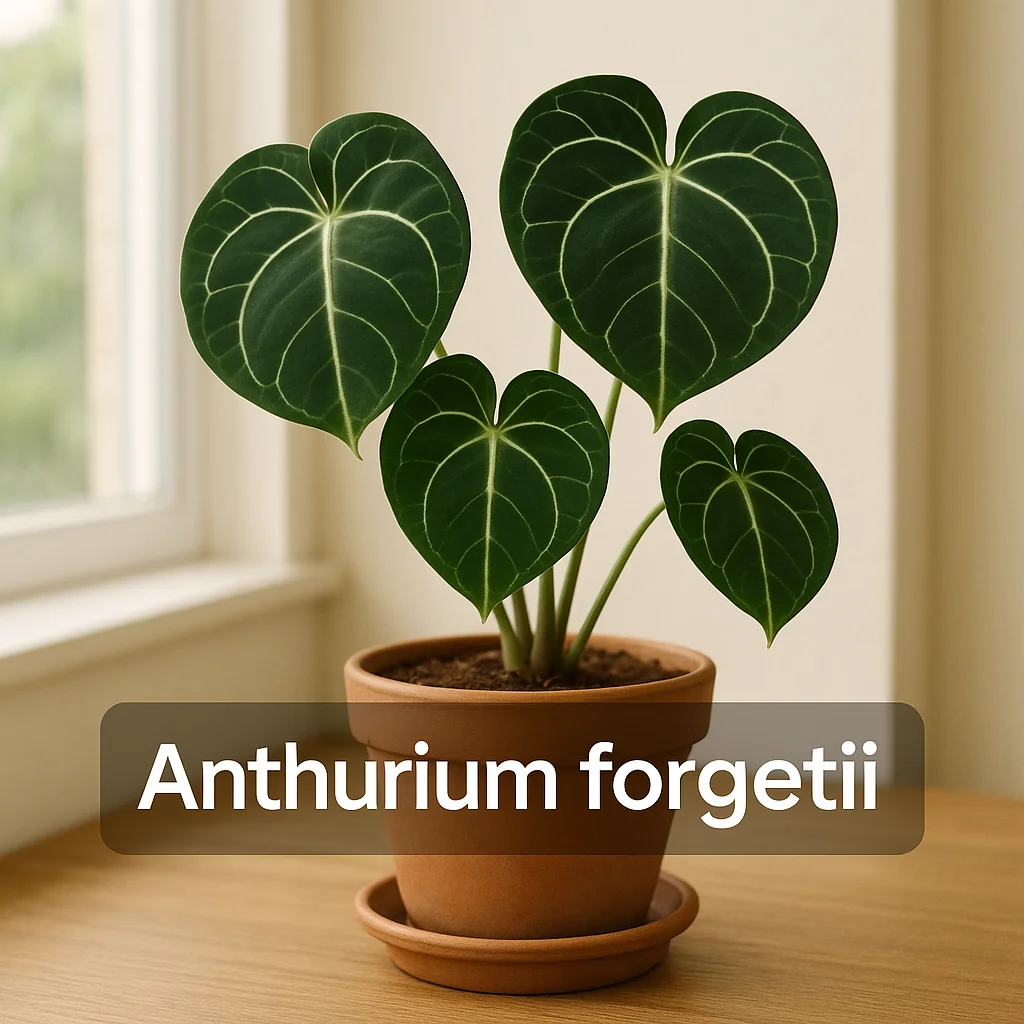
- Common names: Anthurium forgetii
- Scientific name: Often listed as Anthurium forgetii
- Plant type: Foliage
- Growth habit: Upright
- Typical indoor size: 12–24 inches tall
- Growth speed: Moderate
- Lifespan: Can live many years with proper care
- Origin: South America, primarily Colombia
- Light preference: Bright indirect light
- Water needs: Moderate, allowing soil to dry slightly between waterings
- Temperature & humidity preference: Warm, humid environments
- Pet safety: May be irritating/toxic to pets
- Difficulty: Medium
🔍 Identification & Look-Alikes
Anthurium forgetii is recognizable by its stunning leaves that lack the velvety sheen common in other Anthuriums. The leaves are rounded with no sinus, a characteristic feature. They typically exhibit intricate veining and are generally dark green, accented with striking white or silver patterns.
The plant has short stems, and the foliage grows in a neat, upright habit. Flowers, if producing indoors, are subtle and do not compete with its foliage. To tell it apart from look-alikes, such as Anthurium crystallinum or Anthurium clarinervium, note its full rounded leaves and the absence of a sinus.
- Leaves are rounded without the typical Anthurium sinus
- Dark green leaves with white/silver veining
- Compact and upright growth habit
- Short, sturdy stems
- Less flashy flowers, primarily grown for foliage
- More subtle when compared to similar species like Anthurium clarinervium
🌍 Origin & Natural Habitat
Native to Colombia, Anthurium forgetii thrives in warm, humid, and shaded forest understories. It flourishes at mid to low elevations where the environment is consistently humid and the temperature is moderately warm year-round.
Understanding its natural habitat guides indoor care, emphasizing the need for high humidity and bright, indirect light to replicate its native forest conditions.
☀️ Light Requirements
Anthurium forgetii performs best in bright, indirect light, mimicking the dappled sunlight it receives in its native habitat. Ideally, place it near an east or north-facing window, ensuring it receives ample light without direct exposure, which can bleach the leaves.
Insufficient light may lead to reduced foliage gloss and slow growth, while too much direct light can cause leaf scorch.
- Position near a bright, indirect light source
- Avoid direct sunlight to prevent leaf damage
- Watch for signs of too little light: reduced growth, dull leaves
- Monitor for too much light: scorched leaf tips, faded colors
- Adjust position as seasons change to maintain appropriate light levels
- Consider supplemental grow lights in particularly low-light environments
💧 Watering & Humidity
Water Anthurium forgetii thoroughly and let the top inch of the soil dry between waterings. Adjust the watering frequency based on season and light levels, as more light and heat typically increase evaporation.
High humidity is essential for Anthurium forgetii, and using a humidifier or placing the plant on a humidity tray can be beneficial. Signs of overwatering include yellowing leaves and soggy soil, while underwatering may cause browning leaf edges and limpness.
- Water thoroughly, allowing top soil to dry slightly
- Increase frequency during brighter, warmer months
- Maintain high humidity with a humidifier or humidity trays
- Watch for overwatering: yellow leaves, mushy roots
- Signs of underwatering: curled, crispy leaves
- Avoid waterlogged conditions; ensure good drainage
🐛 Soil, Pot & Repotting
A well-draining, chunky soil mix that retains some moisture is ideal for Anthurium forgetii. Consider using a mix of orchid bark, perlite, and quality potting soil. Choose a pot with drainage holes to prevent root rot.
Repotting is typically required every 1–2 years, or when the plant becomes rootbound. Look for signs such as roots poking through drainage holes or slowed growth. During repotting, gently handle the root ball and opt for a pot that's only slightly larger than the previous one.
- Select airy, well-draining soil
- Use pots with adequate drainage
- Repot when rootbound or growth is reduced
- Choose a pot slightly larger than the current size
- Handle roots with care to avoid damage
- Incorporate perlite or orchid bark for airiness
🌡️ Temperature, Airflow & Seasonal Care
Anthurium forgetii prefers consistent temperatures ranging from 65°F to 75°F. It thrives in environments with stable temperatures and good air circulation but should be protected from drafts and sudden temperature swings.
During the winter months, the plant's growth may slow due to lower light levels, so reduce watering accordingly to prevent root rot.
- Maintain temperatures between 65°F and 75°F
- Avoid placing near drafts or heat sources
- Ensure good airflow to prevent fungal issues
- Reduce watering during cooler months
- Watch for seasonal changes in growth patterns
🌸 Flowers, Fruit & Growth Cycle
Though Anthurium forgetii can produce flowers indoors, it is predominantly grown for its magnificent foliage. The blooms, when present, are less vibrant and tend to appear sporadically rather than on a seasonal cycle.
Pruning should be performed with clean tools, focusing on removing dead leaves and maintaining its shape.
🧬 Propagation & Reproduction
Propagation of Anthurium forgetii is typically done through division due to the plant's clumping habit. The process can be challenging but rewarding. Division should be done when repotting, ensuring each new division has sufficient roots attached.
Other methods like leaf or stem cuttings are less common and typically less successful for home growers.
- Best propagated by division
- Ensure each division has healthy roots attached
- Propagate during repotting for best results
- Handle divisions gently to avoid root damage
- Patience is key; growth may initially slow post-propagation
🌿 Common Problems, Pests & Prevention
Common issues for Anthurium forgetii include yellowing leaves due to overwatering, and brown leaf tips from insufficient humidity. Leggy growth often occurs under low light conditions.
Pests like spider mites, mealybugs, and scale can affect this plant. Regularly inspecting and cleaning the foliage helps in prevention. Ensuring stable care and not overwatering reduces stress on the plant, making it less vulnerable to infestations.
- Regularly inspect for pests like spider mites and scale
- Avoid overwatering to prevent root rot
- Clean leaves to reduce pest habitat
- Increase humidity to avoid brown tips
- Provide consistent care to avoid stress
- Separate new or infested plants to quarantine
🐾 Pet & Home Safety Notes
Anthurium forgetii, like many in its genus, may irritate if ingested by pets or children. It is advisable to place the plant where curious pets or small children cannot reach it.
If ingestion is suspected, contact a professional or local poison control resources to get advice on next steps.
🏡 Styling Ideas & Best Room Placement
Due to its preference for humidity, Anthurium forgetii is well-suited for bathrooms or kitchens. It can also be placed on tables or shelves as a centerpiece where its foliage can be admired.
Pair it with other humidity-loving plants like ferns or orchids to create an attractive and harmonious indoor plant arrangement.
📌 Summary
- Anthurium forgetii boasts rounded, ornate leaves
- Native to Colombia, thriving in warm, humid conditions
- Prefers bright, indirect light; avoid direct sun
- Moderate watering needs; high humidity is beneficial
- Use well-draining soil, repot around every 2 years
- Consistent temperatures between 65°F and 75°F are ideal
- Division is the most effective propagation method
- Watch for common pests and maintain good plant hygiene
- Considered medium in care difficulty; takes patience
- Keep out of reach of pets and children due to potential irritation