🌱 Peperomia prostrata (String of Turtles)
🧾 Quick Facts
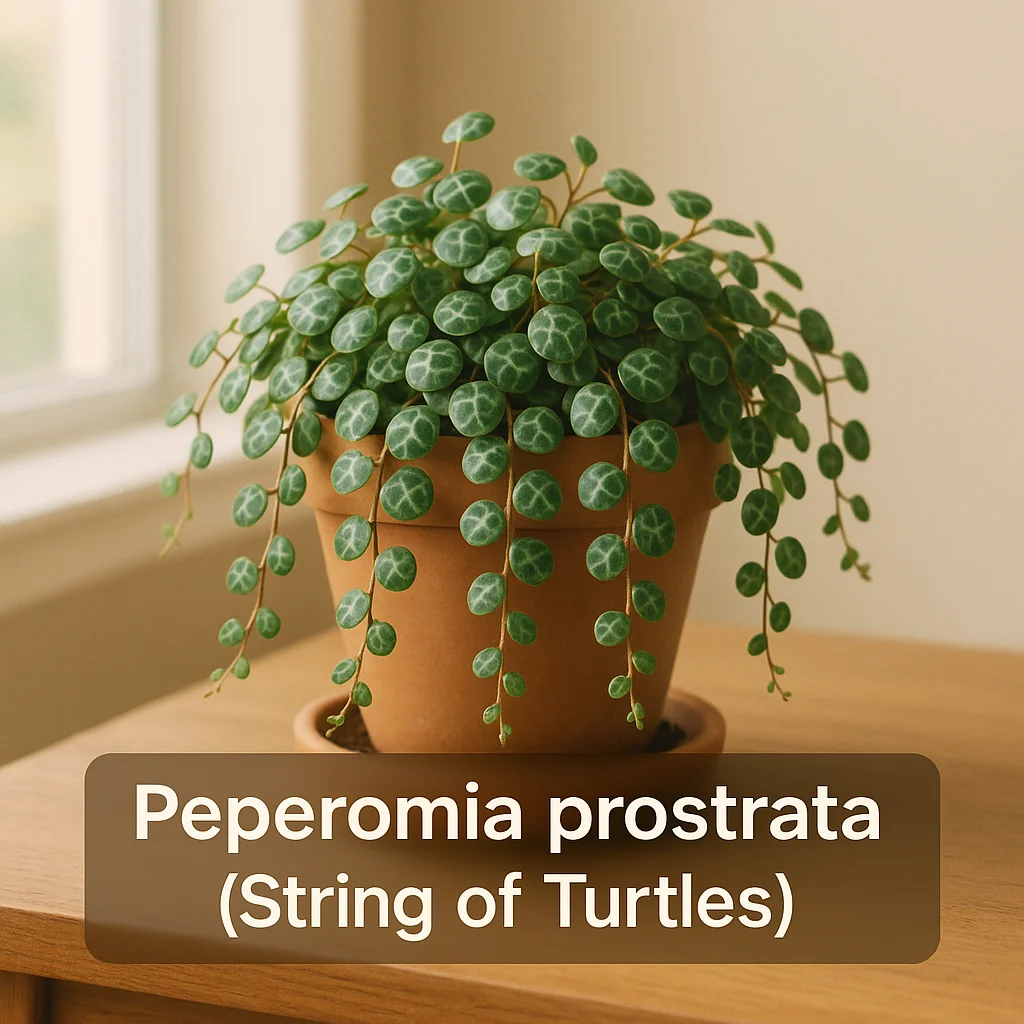
The Peperomia prostrata, or String of Turtles, is a charming trailing houseplant that captures the heart with its small, intricately patterned leaves. Often appreciated for its distinctive foliage, this plant is a delightful addition to any indoor plant collection.
- Common names: String of Turtles, Creeping Button
- Scientific name: Peperomia prostrata
- Plant type: Succulent vine
- Growth habit: Trailing
- Typical indoor size: 1-2 ft long
- Growth speed: Slow
- Lifespan: Can live many years with care
- Origin: South America (Brazilian rainforests)
- Light preference: Bright indirect light
- Water needs: Moderate; prefers soil to dry out slightly between waterings
- Temperature & humidity preference: Prefers warm temperatures and medium to high humidity
- Pet safety: Generally considered pet-friendlier
- Difficulty: Medium
🔍 Identification & Look-Alikes
Peperomia prostrata is easily recognized by its small, rounded leaves resembling turtle shells, with intricate white veining and mottled green hues. The leaves are succulent-like, retaining moisture well, and grow on slender, trailing stems. This plant does not typically flower indoors, and is grown primarily for its foliage.
- Top ID Tips:
- Small, turtle-shell patterned leaves
- Trailing stems
- Dark green coloration with white veining
- Compact, succulent-like foliage
- No significant flowers indoors
- May be confused with String of Dolphins or String of Pearls but identifiable by unique leaf shapes
🌍 Origin & Natural Habitat
The Peperomia prostrata is native to the rainforests of Brazil, where it thrives in the warm, humid understory. Here, it grows epiphytically on trees, taking advantage of the filtered light and rich organic matter. Understanding this natural habitat helps inform its care indoors, emphasizing the importance of maintaining similar humidity and light conditions to ensure healthy growth.
☀️ Light Requirements
For optimal growth, place String of Turtles in bright, indirect light. Windows facing east or north are ideal, as they provide diffused light without the intensity of direct midday sun. Bright indirect light can be mimicked with sheer curtains or by positioning the plant a few feet away from a bright window. Insufficient light can lead to leggy growth, while too much direct sun may scorch the leaves.
- Light Checklist:
- Place near east or north-facing windows
- Avoid intense, direct sunlight
- Use sheer curtains for diffused light
- Monitor for leaf scorching as a sign of too much light
- Look for leggy growth as a sign of too little light
- Adjust position seasonally, if needed
💧 Watering & Humidity
Water Peperomia prostrata using a soak-and-drain method, allowing the soil to dry out partially between waterings. This mimics the natural drying cycles it experiences in its native habitat. In varying seasons and light conditions, adjust watering frequency: less in winter, more in summer. Aim for moderate humidity, enhancing it with a pebble tray or misting. Signs of overwatering include wilting and yellowing, while underwatering often leads to dried, crisp leaves.
- Watering Tips:
- Allow top inch of soil to dry before watering
- Reduce watering in winter
- Consider a porous pot for better drainage
- Use pebble trays to boost humidity
- Check for signs of over or underwatering
- Mist occasionally without soaking the leaves
🐛 Soil, Pot & Repotting
Use an airy, well-draining potting mix to accommodate the Peperomia prostrata's epiphytic nature. A mix designed for succulents or orchids, often comprising bark, perlite, or coarse sand, is suitable. Choose a pot that allows excess water to drain freely—terracotta pots can help manage moisture. Repot when roots show signs of being rootbound or when water flows too quickly. Upsize gradually and handle the delicate roots with care.
- Repotting Checklist:
- Use a succulent or orchid mix
- Select pots with adequate drainage
- Look for roots circling beneath or coming out of the pot
- Repot in spring or early summer
- Be gentle with roots during repotting
- Choose pots only slightly larger than previous
🌡️ Temperature, Airflow & Seasonal Care
Peperomia prostrata thrives in typical room temperatures of 60-80°F. Avoid drafts and temperature swings, such as those from AC or heating vents. During winter, growth slows, so adjust watering accordingly. Provide consistent airflow to prevent fungal issues, but avoid direct drafts. The plant does not undergo a strict dormancy but appreciates stable, nurturing conditions year-round.
- Seasonal Notes:
- Maintain temperatures between 60-80°F
- Avoid direct airflow from vents
- Reduce watering in slow growth periods
- Protect from cold drafts in winter
- Observe reduced growth as a natural cycle
- Ensure steady humidity indoors
🌸 Flowers, Fruit & Growth Cycle
Although Peperomia prostrata may flower under ideal conditions, it is rare indoors and not the primary attraction. The blooms are small and insignificant. Without forming fruits, it focuses energy on leaf and stem development, featuring widely spaced leaves along its delicate vines. Pruning is rarely needed aside from removing dead or damaged foliage, promoting a tidy appearance.
🧬 Propagation & Reproduction
Propagation of String of Turtles can be successfully accomplished through stem cuttings. Cut a segment with several nodes, and place it in a moist potting mix or water. The onset of root development is usually within a few weeks. Leaf propagation is less common and not as successful. Maintain high humidity and stable temperatures during rooting to ensure success.
- Propagation Tips:
- Use healthy stem cuttings
- Include several nodes per cutting
- Root in water or moist soil
- Maintain high humidity during rooting
- Provide bright, indirect light for cuttings
- Be patient—rooting can take weeks
🌿 Common Problems, Pests & Prevention
Peperomia prostrata can face issues like yellowing leaves from overwatering or brown tips from low humidity. Leaf drop and stem rot are other signs of improper care. Pests like spider mites, mealybugs, and fungus gnats may occasionally bother it. Prevent issues by maintaining clean leaves, quarantining new plants, and ensuring stable conditions with good airflow.
- Prevention Basics:
- Keep leaves clean of dust and pests
- Quarantine new plants before introducing
- Provide consistent care and monitoring
- Avoid waterlogged soil
- Increase airflow without creating cold drafts
- Watch for common pest signs and act fast
🐾 Pet & Home Safety Notes
Peperomia prostrata is generally considered safe around pets and children, though some sources suggest mild gastrointestinal upset if parts are ingested. Place it out of reach or use decorative barriers as a precaution. In case of ingestion, contact a professional or local poison control resources for advice. Training pets to avoid nibbling on plants can also help maintain plant health.
🏡 Styling Ideas & Best Room Placement
String of Turtles shines when perched in hanging baskets, cascading over bookshelves, or placed on top of cupboards, where its trailing vines can be displayed. It's well-suited for high humidity locations like bathrooms and kitchens or on desks and tables in living rooms and bedrooms. Consider pairing with other trailing plants, like pothos or philodendron, for a lush, green display.
📌 Summary
- Recognizable by turtle-patterned leaves
- Originates from Brazilian rainforests as an epiphyte
- Prefers bright, indirect light; adjust for seasons
- Water moderately; allow soil to dry between waterings
- Use airy soil mixes; repot when rootbound
- Maintain temperatures away from drafts
- Simple propagation via stem cuttings
- Watch for common pests and maintain clean foliage
- Medium difficulty with slight attention to humidity and watering
- Generally safe around pets if precautions are observed