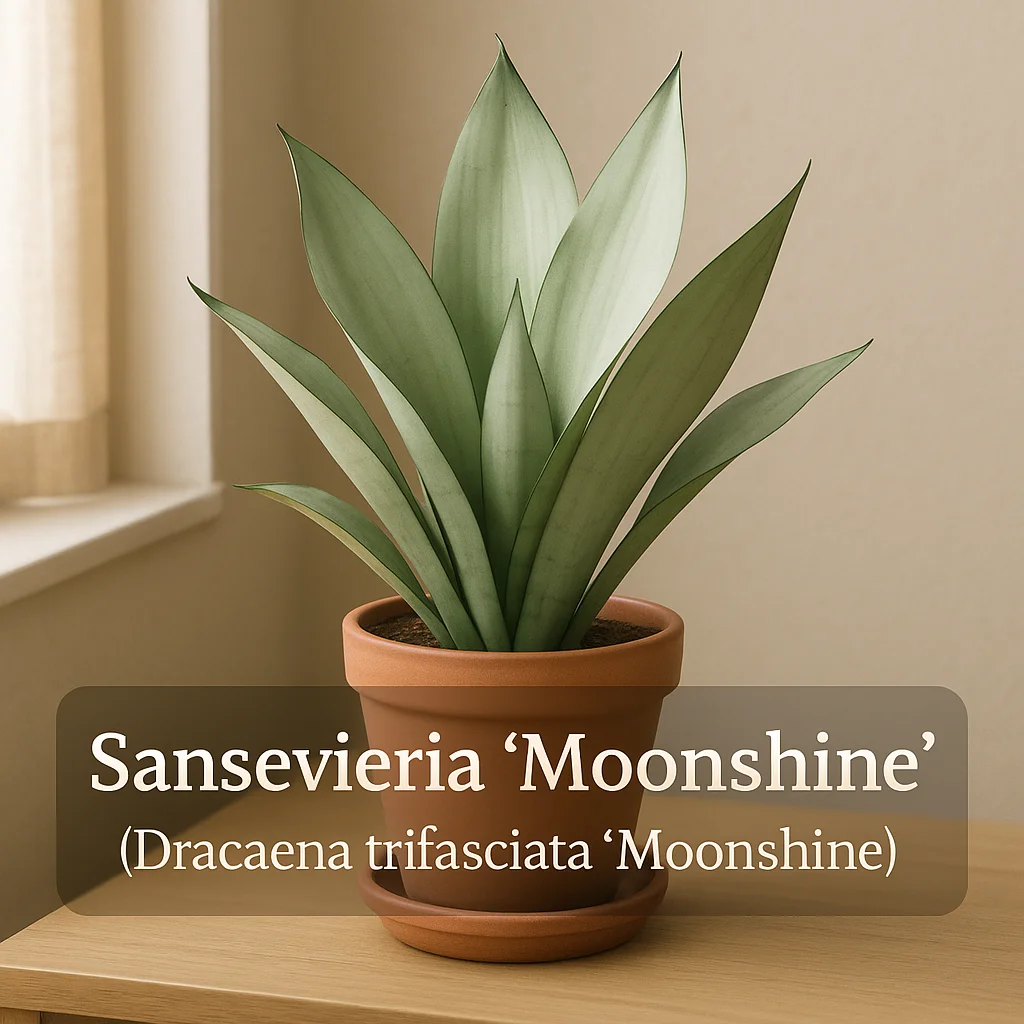
🌱 Sansevieria ‘Moonshine’ (Dracaena trifasciata ‘Moonshine’)
🧾 Quick Facts
Sansevieria ‘Moonshine’, commonly known as the 'Moonshine Snake Plant', is a popular choice for indoor greenery due to its elegant appearance and easy-care nature. Here are some quick facts about this plant:
- Common names: Moonshine Snake Plant, Silver Snake Plant
- Scientific name: Dracaena trifasciata ‘Moonshine’
- Plant type: Succulent
- Growth habit: Upright
- Typical indoor size range: 1 to 3 feet tall, 6 inches to 1 foot wide
- Growth speed: Slow to moderate
- Lifespan: Can live many years with care
- Origin: West Africa (tropical regions)
- Light preference: Bright indirect light to partial shade
- Water needs: Low; prefers to dry out between waterings
- Temperature & humidity preference: Average indoor humidity; prefers temperatures between 60-80°F (15-27°C)
- Pet safety: May be irritating/toxic to pets
- Difficulty: Easy
🔍 Identification & Look-Alikes
Sansevieria ‘Moonshine’ is easily recognized for its pale, silvery-green leaves that grow upright in a rosette form. The leaves are smooth, with a slightly leathery texture, and are more rounded at the base. Unlike other snake plants, Moonshine displays a consistent color with minimal variegation, though lighting can influence shades.
Though Sansevieria rarely flowers indoors, under specific conditions, it may produce small, white to greenish flowers on slender stalks, but this is uncommon and typically not the focus of its cultivation.
Common look-alikes include other Sansevieria varieties like ‘Laurentii’, which has yellow-edged leaves, making it somewhat distinct from the monochrome Moonshine.
- Leaves are silver-green with a smooth, leathery texture.
- Grows in an upright, rosette shape.
- Rarely flowers indoors; grown mainly for foliage.
- Moonshine color may be influenced by light levels.
- Distinguished by lack of variegation.
- Distinct from Sansevieria ‘Laurentii’ which has yellow margins.
- Often mistaken for other common snake plant variations.
- If flowering occurs, expect slender stalks with white or greenish blooms.
🌍 Origin & Natural Habitat
The Sansevieria ‘Moonshine’ originates from the tropical regions of West Africa, where it naturally thrives in rocky, arid habitats characterized by infrequent rainfall and well-drained soil. These conditions shape its hardiness and resilience, making it well-suited for indoor environments that mimic a similar dry atmosphere.
Understanding its natural habitat helps in providing care; bright, indirect light and allowing the soil to dry out between waterings provide an environment similar to its native rocky terrain.
☀️ Light Requirements
Sansevieria ‘Moonshine’ thrives in a variety of lighting conditions but prefers bright, indirect light. This can be achieved by placing the plant near an east or west-facing window. Low light conditions can be tolerated but may result in slower growth and less vivid coloring.
Avoid direct, harsh sunlight, as it can cause the leaves to scorch. Conversely, too little light may cause the leaves to lose their rigidity and vibrancy.
- Place near east or west-facing windows for best results.
- Avoid direct sunlight to prevent leaf scorch.
- Thrives in bright, indirect light.
- Tolerates low light but may grow slowly.
- Watch for leaf discoloration or drooping as signs of adjustment.
- Rotate periodically for even growth.
- Supplement with artificial lighting if natural sources are insufficient.
💧 Watering & Humidity
Sansevieria ‘Moonshine’ has low water needs and prefers a cycle of thorough watering followed by allowing the soil to dry out completely. This soak-and-dry method replicates its natural habitat where rain is infrequent.
Pot size, seasonal changes, and light conditions will influence watering frequency. Typically, water every 2-4 weeks, adjusting as necessary by observing soil dryness.
This plant is also tolerant of lower humidity levels found in typical indoor environments. Increase humidity if needed by grouping plants or using a humidifier, especially during dry winter months.
- Allow soil to dry completely between waterings.
- Reduce watering frequency during winter dormancy.
- Adjust frequency for pot size and light conditions.
- Watch for yellowing (overwatering) or browning tips (underwatering).
- Use distilled or rainwater to avoid mineral buildup.
- Consider a humidity tray if air is extremely dry.
🐛 Soil, Pot & Repotting
Choose a well-draining cactus or succulent potting mix for Sansevieria ‘Moonshine’ to prevent water retention. While terracotta pots are popular for their breathability, any pot with appropriate drainage holes will suffice.
Repot every 2-3 years or when you see signs of being rootbound, such as roots growing through drainage holes. Move to a pot just one size larger to avoid excessive soil stay around roots, which can lead to rot.
- Use a cactus or succulent potting mix for drainage.
- Ensure pots have drainage holes to prevent root rot.
- Repot when rootbound or every 2-3 years.
- Choose terracotta for extra breathability.
- Gently loosen roots during repotting to encourage growth.
- Avoid oversized pots to prevent soil moisture retention.
🌡️ Temperature, Airflow & Seasonal Care
Sansevieria ‘Moonshine’ prefers temperatures between 60-80°F (15-27°C) and can tolerate a slight drop in temperature during winter but not below 50°F (10°C). Keep away from drafts, such as air conditioning vents and exterior doors, to prevent stress.
Seasonal care involves reduced watering and slower growth in winter. The plant does not undergo dormancy but its growth will lessen, necessitating less frequent watering and low maintenance.
- Prefers temperatures of 60-80°F (15-27°C).
- Avoid temperatures below 50°F (10°C).
- Ensure stable environments; avoid drafts.
- Expect slower growth in winter; adjust care.
- Adjust watering according to seasonal changes.
- Regular airflow helps prevent fungal growth.
🌸 Flowers, Fruit & Growth Cycle
Sansevieria ‘Moonshine’ is primarily grown for its elegant foliage rather than its flowers. It very rarely blooms indoors, usually requiring specific environmental stressors to initiate flowering. When it does flower, expect small, white to greenish blooms arranged along a spindly stalk.
The plant grows by forming new leaves from the center of its rosette and can eventually develop offsets or pup plants that can be used for propagation.
Pruning is generally unnecessary except to remove any damaged leaves. Clean cuts should be made to avoid introducing disease.
🧬 Propagation & Reproduction
Propagating Sansevieria ‘Moonshine’ is most commonly achieved through division. Mature plants naturally develop offsets, also known as pups, which can be separated when repotting.
Leaf cuttings are another option, though success varies and is often less reliable than division. Ensure cuttings are taken from healthy, mature leaves for best results.
- Propagates best through division of offsets.
- Separate pups during repotting for best results.
- Try leaf cuttings for propagation, though success varies.
- Ensure cuttings are from healthy, mature leaves.
- Handle new growth gently to avoid damage.
- Let cut surfaces callous before planting in substrate.
- Avoid overwatering propagated sections.
🌿 Common Problems, Pests & Prevention
Common issues for Sansevieria ‘Moonshine’ include yellow leaves from overwatering, brown tips from underwatering, and occasional pest infestations like spider mites and mealybugs. Mealybugs and spider mites are small, sap-sucking pests that can damage the plant.
Prevent problems by keeping the plant environment stable, ensuring well-draining soil conditions, and maintaining proper watering schedules. Regular leaf cleaning can also deter pests.
- Overwatering causes yellow leaves; reduce water frequency.
- Brown leaf tips indicate underwatering.
- Check for mealybugs and spider mites regularly.
- Quarantine new plants to prevent pest introduction.
- Regularly wipe down leaves to remove dust and deter pests.
- Monitor for changes in plant condition frequently.
- Avoid rapid environmental changes.
🐾 Pet & Home Safety Notes
Parts of the Sansevieria plant are listed as potentially irritating or toxic if ingested by pets or small children, which may lead to oral irritation or gastrointestinal discomfort. It is advisable to place the plant out of reach or in areas less likely to be disturbed by pets or curious young ones.
If ingestion is suspected, contact a professional or local poison control resources for guidance.
🏡 Styling Ideas & Best Room Placement
The sleek, modern look of Sansevieria ‘Moonshine’ makes it an excellent choice for adding vertical interest to bedrooms, living rooms, or offices. It’s suitable for lower light places like hallways or bathrooms provided the rest of its care conditions are met.
Consider planting it in a simple, elegant pot to accentuate its minimalist look. Pair with other indoor plants like ferns or low-light-tolerant peace lilies to create contrast and diversity in your plant displays.
📌 Summary
- Identified by silver-green leaves and upright growth.
- Originates from West African tropical areas.
- Thrives in bright indirect to partial shade light.
- Low water needs; prefer dry cycles.
- Requires well-draining soil and moderate repotting cycles.
- Tolerates standard indoor temperature; sensitive to drafts.
- Can be propagated via offsets division.
- Common problems include overwatering and pest infestation.
- Considered easy to grow; handle with care for pets and children.
- Stylish addition for varied indoor settings.